The next recycling revolution won’t come from factories, it will come from enzymes.
At the ICP-CSIC, the Directed Enzyme Evolution Group is pushing the boundaries of biotechnology with a mission that sounds like science fiction: teaching enzymes to “eat” the sustainable plastics of the future. While traditional recycling relies on heat, pressure or chemicals, nature has a quieter and far more elegant solution, enzymes.
These microscopic catalysts already perform incredible transformations every second inside living organisms. Now, science is learning to guide and enhance their abilities to help us face one of the greatest environmental challenges of our time: plastic waste.
The team at ICP-CSIC is developing lab-evolved enzymes capable of breaking down bio-based thermoplastic compounds, including unsaturated polyesters (bUP) and epoxy resins (bEPO), materials designed to replace conventional petroleum-based plastics.
Through a powerful combination of directed evolution and machine learning, researchers can identify the exact mutations that improve enzyme performance, making them faster, more stable, and more efficient at attacking polymer chains that were once thought to be almost indestructible.
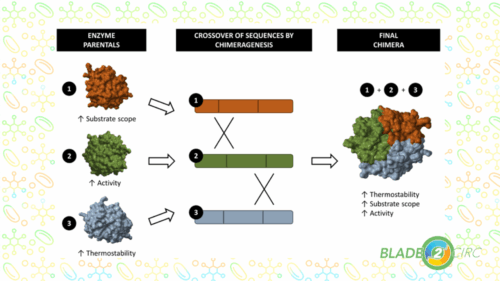
In parallel, a new frontier is being explored: protein chimeragenesis. This cutting-edge technique combines fragments of enzymes from diverse natural sources, creating hybrid biocatalysts with enhanced degradation power and unique biochemical properties.
It’s a bit like assembling the best traits from different biological “parents” into a single, superior enzyme.
The goals are clear:
👉 To make future materials return safely to nature, closing the loop of production and reuse.
👉 To turn the circular bioeconomy from a visionary concept into an everyday reality.
Because the real innovation of tomorrow might not come from machines, but from the invisible power of biology. Maybe the recycling heroes of the future won’t wear lab coats, they’ll have spiral molecular structures.
Stay tuned for more updates as we continue our work to transform the wind energy industry and create a greener, more sustainable future.