The University of Limerick, through its work in the BLADE2CIRC project, has reached a major milestone in the journey toward fully circular composite materials. The team has successfully scaled up the production of lignin-based fibres from laboratory to pilot scale, demonstrating their growing potential for real industrial deployment.
This breakthrough is more than just a technical step forward, it marks a shift in how bio-based materials can enter high-performance sectors traditionally dominated by fossil-derived products.
One of the most significant achievements is UL’s transition from monofilament to multifilament fibres, a move that now enables their conversion into carbon fibre reinforcement preforms. These preforms are key components in advanced composite structures, including the next generation of circular wind turbine blades envisioned within BLADE2CIRC.
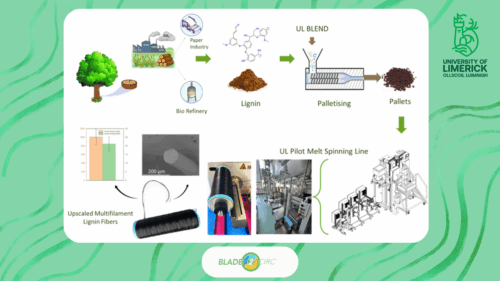
Lignin, a natural polymer found in wood and typically generated as a by-product of the pulp and paper industry, is being transformed into lightweight, strong, and sustainable fibres. UL’s innovative process shows how industrial bio-waste can be repurposed into high-value materials with excellent performance characteristics.
As one of the most promising bio-based alternatives to conventional reinforcement fibres, lignin-based fibres offer a pathway toward composites that are not only lighter and stronger but also far more sustainable. This progress highlights UL’s leadership in green materials science and represents an important leap toward BLADE2CIRC’s mission to create circular wind turbine composite structures.
By advancing the scalability of lignin fibres, UL is helping support Europe’s transition to a bio-based, resource-efficient future, where renewable materials play a central role in next-generation engineering.
Stay tuned for more updates as we continue our work to transform the wind energy industry and create a greener, more sustainable future.