The Directed Enzyme Evolution group showed our advances in the EU project #BLADE2CIRC, during the biannual congress BIOTRANS, held at Basel (Switzerland) from June 29-July 3, 2025. An important gathering that highlights the most recent global breakthroughs in biocatalysis research.
The group, represented by the PhD student Julia Murciano, showcased in a flash presentation the significance of evolved enzymes within the context of the project and explained how we are developing biosolutions to degrade thermoplastic composites, such as bUP or bEPO resins, aligned with the principles of the circular economy.
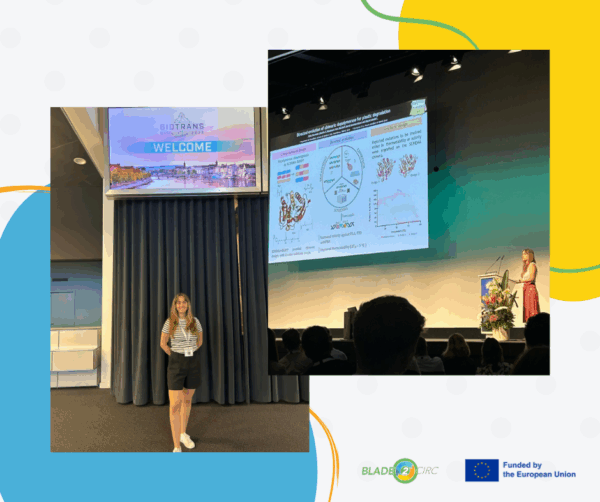
Through the combined power of Directed Evolution and advanced machine learning predictions, ICP-CSIC has successfully identified key mutations that enhance hydrolytic enzyme performance to break down polymers commonly found in next-generation bio-based resins. Despite these enzyme mutants represent a crucial step toward sustainable composite material management, further engineering is being applied to meet industrial demands, focusing on optimizing the biopolyesters degradation activity, while improving enzyme thermostability at operational temperatures.
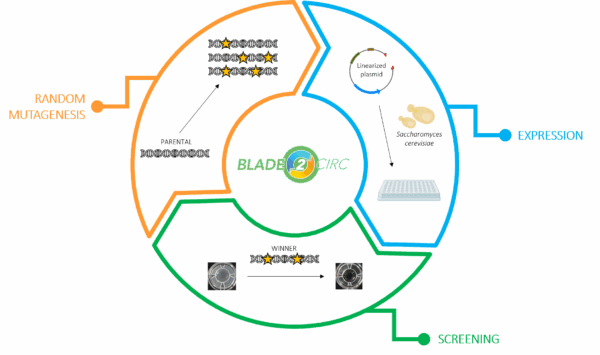
This strategy blends cutting-edge biotechnology, enzyme engineering, and the latest machine-learning tools, obtaining a greener composite material degradation and its potential recovery.
Let’s unveil the power of the engineered enzymes in #BLADE2CIRC!