The transition towards more sustainable wind energy systems requires innovation not only in energy generation, but also in the materials used to build the infrastructure itself.
Within BLADE2CIRC, Specific Polymers is contributing to this transition through the development of a new adhesive system based largely on bio-based raw materials and free from bisphenol compounds. The aim is to move away from conventional fossil-based formulations while maintaining the high technical performance required in blade manufacturing.
This new two-component epoxy adhesive has been specifically designed for wind turbine blade applications. During development, special attention has been paid to two critical parameters in industrial processing: viscosity and adhesion strength.
Achieving the right balance is essential to ensure proper application during manufacturing and long-term structural reliability of the bonded components.
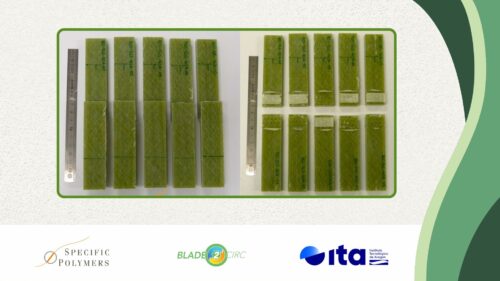
One of the main challenges in replacing traditional adhesives is ensuring that more sustainable alternatives can deliver equivalent performance under real industrial conditions. For this reason, rigorous testing has been carried out by ITA using the Single Lap Shear (SLS) method, a standard approach to evaluate bonding performance. The results indicate that this high bio-based adhesive achieves performance levels comparable to established petrochemical-based commercial solutions.
These findings are particularly relevant in the context of wind blade manufacturing, where reliability, durability, and safety are non-negotiable requirements. Demonstrating that bio-based formulations can meet these standards is an important step towards broader industrial adoption.
Beyond the technical validation, this development also contributes to the wider objectives of BLADE2CIRC, supporting the transition towards more circular value chains in composite materials. By integrating bio-based chemistry into high-performance applications, the project helps reduce dependence on fossil resources and moves the sector closer to more sustainable production models.
Further progress and results from the project will continue to be shared as development advances.
Stay tuned for more updates as we continue our work to transform the wind energy industry and create a greener, more sustainable future.