Improved Resin Infusion for Circular Wind Turbine Blades
Inside Aitiip’s lab, an improved resin is being tested through the same process used to manufacture real wind turbine blades — one more step toward circular composites within Blade2Circ.

Inside Aitiip’s lab, an improved resin is being tested through the same process used to manufacture real wind turbine blades — one more step toward circular composites within Blade2Circ.
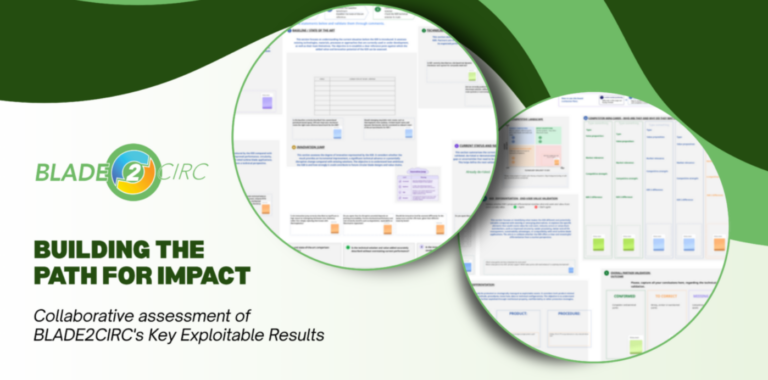
Within the framework of BLADE2CIRC, INCOTEC is currently coordinating the technology assessment of the prioritised Key Exploitable Results (KERs) together with the technical partners.
At KTH, work is focused on the development of different end-of-life scenarios and strategic routes for blade materials and products.
The transition towards more sustainable wind energy systems requires innovation not only in energy generation, but also in the materials used to build the infrastructure itself.
Centexbel is working on textile reinforcements made from lignin, a material with great potential as a greener alternative and as a precursor for carbon fiber.
Developing innovative bio-based composite systems represents a major step toward enabling more circular wind turbine blades.
For new materials to create real impact beyond the laboratory, scalability is a critical factor. Research outcomes must be translated into materials that can be produced at sufficient volumes, meet strict quality requirements, and be validated under real industrial conditions.
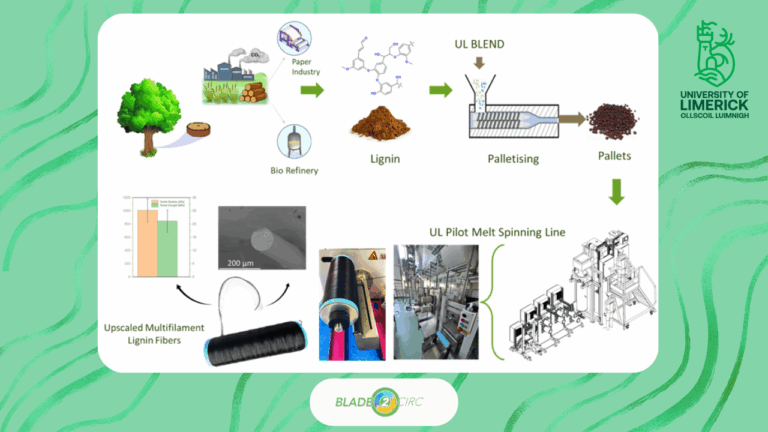
The team has successfully scaled up the production of lignin-based fibres from laboratory to pilot scale, demonstrating their growing potential for real industrial deployment.
The team has successfully scaled up the production of lignin-based fibres from laboratory to pilot scale, demonstrating their growing potential for real industrial deployment.
The team has successfully scaled up the production of lignin-based fibres from laboratory to pilot scale, demonstrating their growing potential for real industrial deployment.
The team at ITA is developing a self-healing coating designed for wind turbine blades.
At the ICP-CSIC, the Directed Enzyme Evolution Group is pushing the boundaries of biotechnology with a mission that sounds like science fiction: teaching enzymes to “eat” the sustainable plastics of the future.