Improved Resin Infusion for Circular Wind Turbine Blades
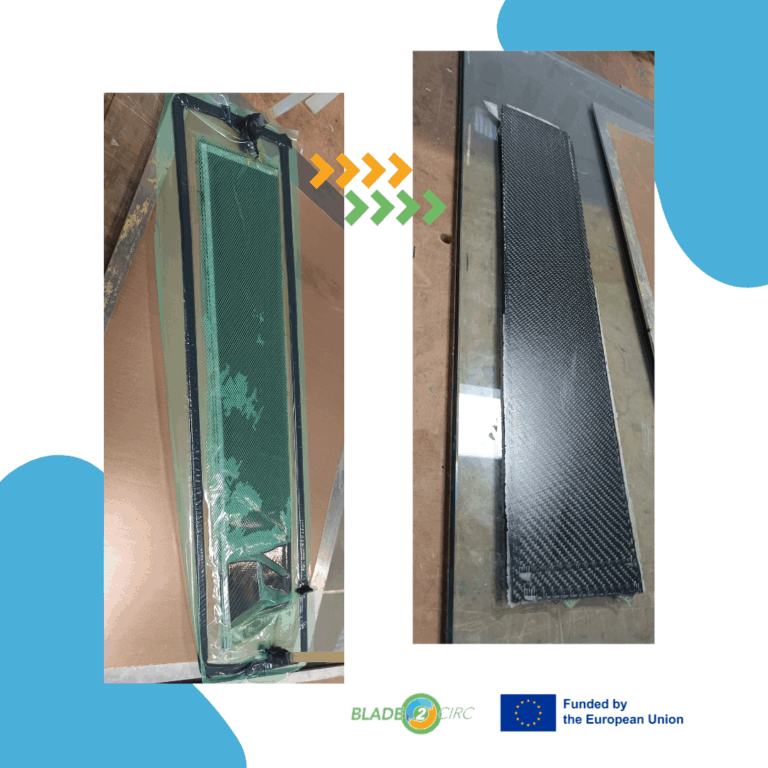
Inside Aitiip’s lab, an improved resin is being tested through the same process used to manufacture real wind turbine blades — one more step toward circular composites within Blade2Circ.

Inside Aitiip’s lab, an improved resin is being tested through the same process used to manufacture real wind turbine blades — one more step toward circular composites within Blade2Circ.
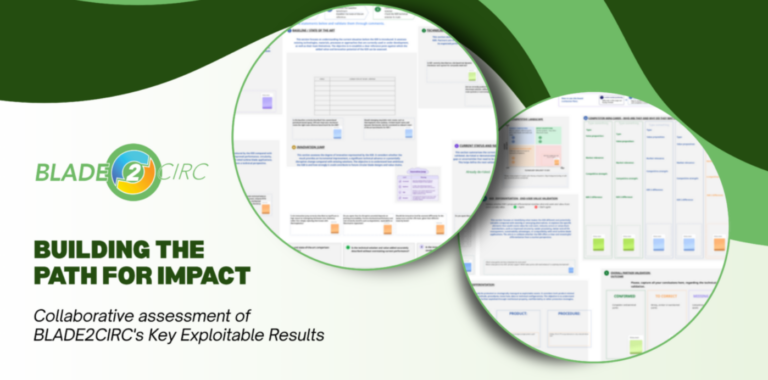
Within the framework of BLADE2CIRC, INCOTEC is currently coordinating the technology assessment of the prioritised Key Exploitable Results (KERs) together with the technical partners.
At KTH, work is focused on the development of different end-of-life scenarios and strategic routes for blade materials and products.
The transition towards more sustainable wind energy systems requires innovation not only in energy generation, but also in the materials used to build the infrastructure itself.
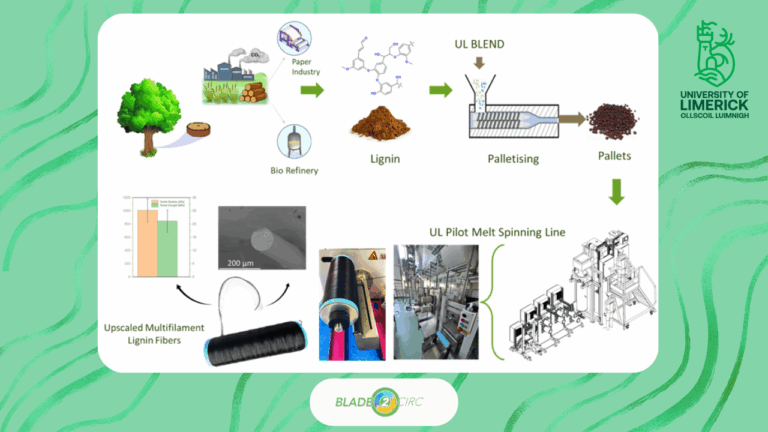
Centexbel is working on textile reinforcements made from lignin, a material with great potential as a greener alternative and as a precursor for carbon fiber.
Developing innovative bio-based composite systems represents a major step toward enabling more circular wind turbine blades.
For new materials to create real impact beyond the laboratory, scalability is a critical factor. Research outcomes must be translated into materials that can be produced at sufficient volumes, meet strict quality requirements, and be validated under real industrial conditions.
The team has successfully scaled up the production of lignin-based fibres from laboratory to pilot scale, demonstrating their growing potential for real industrial deployment.
The team has successfully scaled up the production of lignin-based fibres from laboratory to pilot scale, demonstrating their growing potential for real industrial deployment.
The team has successfully scaled up the production of lignin-based fibres from laboratory to pilot scale, demonstrating their growing potential for real industrial deployment.
The team at ITA is developing a self-healing coating designed for wind turbine blades.
At the ICP-CSIC, the Directed Enzyme Evolution Group is pushing the boundaries of biotechnology with a mission that sounds like science fiction: teaching enzymes to “eat” the sustainable plastics of the future.
At the ICP-CSIC, the Directed Enzyme Evolution Group is pushing the boundaries of biotechnology with a mission that sounds like science fiction: teaching enzymes to “eat” the sustainable plastics of the future.
For new materials to have real-world impact, they must be produced at sufficient volumes to be tested, validated, and adopted by manufacturers across the wind energy sector. Scalability is crucial!
The Directed Enzyme Evolution group showed our advances, during the biannual congress BIOTRANS, held at Basel (Switzerland) from June 29-July 3, 2025. An important gathering that highlights the most recent global breakthroughs in biocatalysis research.
Among the different technologies being researched within the project, particularly in this first period, ITA is making progress on the development of adhesive joints with debonding-on-demand capacity (DoD) and self-healing coatings.
As part of the BLADE2CIRC project, our partners at the University of Limerick, represented by Professor Maurice N Collins and Dr Kashif Bangash, attended the International Conference on Manufacturing of Advanced Composites (ICMAC) 2025 in Coventry.
At BIOTRANS 2025, EvoEnzyme will present these promising findings, highlighting their potential to revolutionise the recycling process for wind turbine blades.
Aitiip’s presence at JEC World 2025 offered a unique platform to showcase the significant progress made within Blade2Circ.
We are dedicated to improving the sustainability of wind energy systems throughout their life cycle. By utilizing our innovative bio-based resin and lignin fibres during the construction phase, we will enhance both repairability and recyclability while maintaining high performance. A key partner in achieving this goal is EireComposites.
At BLADE2CIRC, we are committed to tackling the challenges of sustainability and recyclability in composite materials. One of our key collaborators, Centexbel, plays a crucial role in advancing this mission by bringing decades of expertise in textiles and plastics to the table.
In BLADE2CIRC, to enhance the sustainability and recyclability of wind turbine blades, SPECIFIC POLYMERS plays a pivotal role. Their innovations in bio-based materials and advanced recycling technologies are actively shaping the future of wind energy.
The BLADE2CIRC project is tackling this challenge head-on, and our partner, KTH Royal Institute of Technology, is driving innovation to redefine end-of-life (EoL) strategies for wind turbine blades.
As the project progresses, new developments and key milestones will continue to emerge, driven by the collaborative efforts of all partners. In this post you get to know the role of Incotec.
Blade2Circ aims to improve wind turbine recyclability by designing components that facilitate blade dismantling, such as a reversible adhesive, as well as developing new chemical and enzymatic degradation processes to address resin end of life.