BLADE2CIRC is all about developing more circular and greener solutions for wind turbine blades. Several technologies are being researched within the project, and one of them is a self-healing coating. Over the last few months, ITA (Instituto Tecnológico de Aragón) has been moving this work forward.
A self-healing coating based on microencapsulation
The coating ITA is working on gets its self-healing properties from microencapsulation. In other words, a repairing substance is enclosed in tiny capsules, known as microcapsules, which are then added to the coating. If the surface is scratched, the idea is that this substance is released and heals the damage.
Two partners, one self-healing coating
The work is shared between two BLADE2CIRC partners. Specific Polymers is handling the development of the resin. ITA, for its part, is responsible for synthesising the microcapsules and then incorporating them into the resin matrix.
H2: What is ITA testing right now?
At the moment, the team’s work focuses on two kinds of tests.
The first are dispersion stability tests. These look at whether the microcapsules stay well dispersed in the matrix once they have been added.
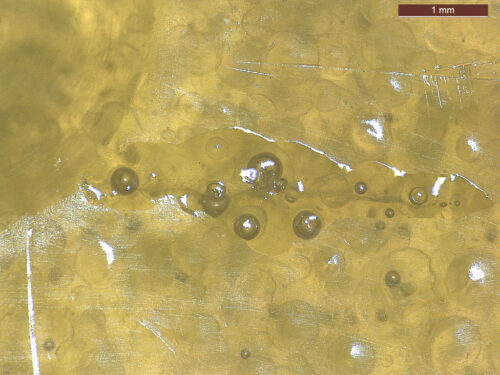
The second are trials to check that the repairing substance is actually released and that the healing process takes place. To do this, the team scratches the coating on purpose and then looks at what happens.
So what does one of these scratch trials look like? This is a sample of the coating under the microscope after it has been scratched. Images like this one help the team check whether the healing agent has been released.
From the lab to Hi! Plastics
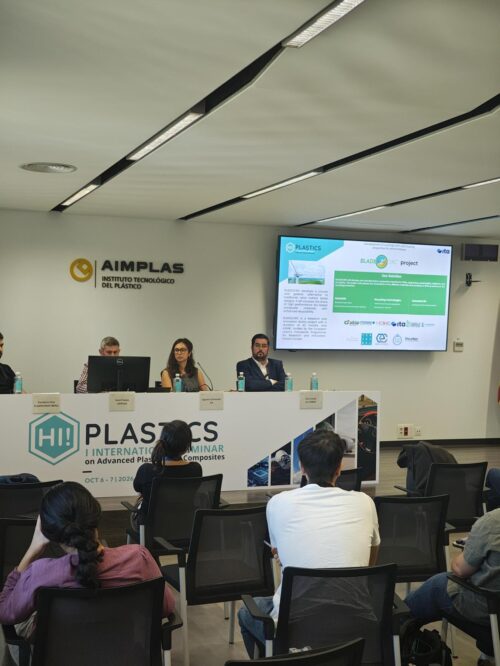
The work has also travelled beyond the lab. In October, ITA presented part of these results at the Hi! Plastics international seminar on advanced plastic materials, organised by AIMPLAS in Valencia, Spain, on 6 and 7 October.
In the photo below, you can spot BLADE2CIRC on the big screen during the session.
What’s next for the self-healing coating?
The dispersion and healing trials are still under way at ITA, and we’ll share more as the work moves forward. In the meantime, you can find out more about the project on our About page, or read how ICP-CSIC is engineering enzymes for composite recycling within BLADE2CIRC.
Want to keep up with BLADE2CIRC and its partners? Follow the project on LinkedIn for the latest news from the consortium.