Blade2Circ is moving forward on one of its key manufacturing routes, resin infusion. Building on the bio-based resin tests completed earlier in the project, partner Aitiip Centro Tecnológico is now validating an improved resin for the process. It’s the same process used to build full-scale wind turbine blades, so every test brings the project a step closer to a material the wind energy industry can actually adopt.
What Resin Infusion Involves
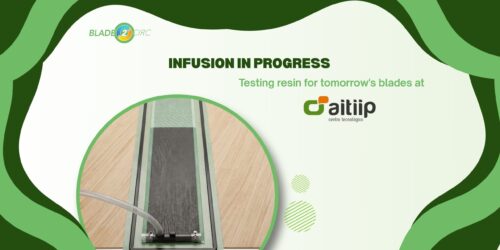
Resin infusion starts with dry fibre reinforcement laid inside a mould and sealed under a vacuum bag. Once the vacuum is applied, liquid resin is drawn through the fibre, flowing until it reaches and saturates every layer. The resin then cures, bonding fibre and matrix into a single rigid structure, the same composite material wind turbine blades are built from at full industrial scale. It’s a controlled, repeatable process, and that’s why it works so well for testing and refining the new materials Blade2Circ is exploring.
Validating the Improved Resin
Right now, the project is focused on validating this improved resin for the infusion process and checking how well it impregnates the fibre, work carried out in Aitiip’s lab. The team studies how the resin flows once it meets the fibre, how evenly it spreads through every layer, and whether it leaves any dry spots or trapped air behind. Each sample is infused, cured and inspected, and every round of testing narrows down what works, bringing this new formulation a step closer to real industrial use.
Why the Real Manufacturing Process Matters
This attention to detail matters because a resin that only performs well in a small, controlled lab sample doesn’t say much about how it will hold up in a full-scale blade exposed to wind, salt and fatigue over decades in the field. A resin that performs well through the same infusion process used on the factory floor is one the wind energy industry can actually consider adopting. That’s the gap this testing is meant to close, one validated sample at a time.
A Step Toward Circularity
Wind turbine blades have long been difficult to recycle. Once fibre and resin cure together, they form a single bonded material that can’t simply be melted down or separated the way metal components can. That’s the challenge circular economy solutions for composites need to solve. Refining the resin formulation, rather than settling for the first version that works, is how Blade2Circ keeps pushing that balance further. The project validates materials and processes that perform reliably during manufacturing while keeping future recyclability in mind, helping lay the foundation for wind turbine blades designed for a full circular life cycle, from production to eventual reuse.
Part of a Bigger Picture
Resin infusion is only one piece of what Blade2Circ is working on. The project’s wider goal is to build real circular pathways for wind turbine blades, covering the materials and manufacturing processes used today and how those blades can eventually be recovered and reused once they reach the end of their working life. This resin validation work feeds directly into that goal, making sure the materials side of the equation holds up before circularity can even be considered.
Stay tuned for more updates as Blade2Circ continues turning meticulous resin infusion testing into real circular pathways for the wind energy industry.
You can also find this update on our LinkedIn: https://www.linkedin.com/feed/update/urn:li:activity:7502992025546342400