In BLADE2CIRC, we continue to advance our understanding of how to improve the circularity of wind turbine blades across their entire life cycle.
At KTH, work is focused on the development of different end-of-life scenarios and strategic routes for blade materials and products. This includes a detailed analysis of how value chains behave within the project, considering not only technological aspects, but also regulatory frameworks, operational conditions, and decision-making processes that ultimately determine how and where these materials flow.
A key milestone in this work has been the definition of key performance indicators (KPIs) and value chain structures within Deliverable D3.1. This deliverable has provided a solid foundation for all subsequent modelling activities within the project.
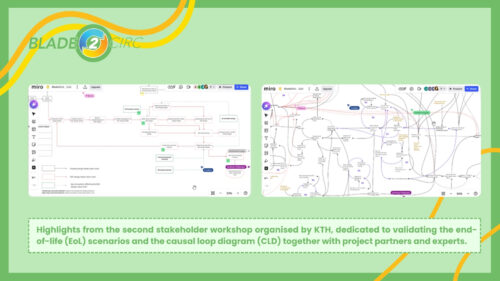
Building on this basis, KTH has developed the end-of-life scenarios, the causal loop diagram (CLD), and is now progressing towards the system dynamics (SD) model. This model enables a deeper understanding of how the transition towards more circular blade designs, combined with the adoption of innovative solutions, affects the entire system over time, from blade production and first-life use, through end-of-first-life decisions, and ultimately to overall circularity outcomes.
A particularly important activity in this phase has been the second stakeholder workshop, organised by KTH. This collaborative session brought together project partners and experts to review and validate the proposed end-of-life scenario structure and the initial conceptual model. The discussions and feedback collected during the workshop have been essential to refine the modelling approach and ensure that it accurately reflects real-world constraints and decision-making dynamics.
Looking ahead, KTH is currently preparing the third stakeholder workshop, planned for June. This upcoming session will focus on presenting the developed system dynamics model and the results of the scenario analysis. It will also provide an opportunity to explore how the model can be used as a decision-support tool to assess future end-of-life pathways and evaluate circularity performance under different conditions.
Stay tuned for more updates as we continue our work to transform the wind energy industry and create a greener, more sustainable future.