Enzymatic recycling of composites could one day help recover materials from wind turbine blades at the end of their life. Within the BLADE2CIRC project, the Directed Enzyme Evolution group at the Instituto de Catálisis y Petroleoquímica (ICP-CSIC), led by Miguel Alcalde, is developing enzymes for this route. Over the past months, the team has made good progress on one property in particular: resistance to heat.
Why enzymatic recycling of composites needs heat-resistant enzymes
Enzymes are proteins that speed up chemical reactions. Some of them, known as depolymerases, can cut long polymer chains such as polyesters into smaller pieces. The catch is that polyester degradation happens at high temperatures, and many enzymes lose their activity when things heat up. That is why the ICP-CSIC team is working on thermostability, so that new enzyme variants keep doing their job as the temperature rises.
Directed evolution, guided by machine learning
To obtain these variants, the group uses directed evolution, a method that reproduces natural evolution in the laboratory. Researchers create many versions of an enzyme, test them and keep the best ones for the next round.
In BLADE2CIRC, ICP-CSIC is now validating a directed evolution pipeline guided by machine learning. The algorithms help predict which changes are most likely to work, so each round of experiments can focus on the strongest candidates. The aim is to design biopolyester depolymerases that are both highly active and stable.
Next step: testing on plastics and resins
Once the pipeline delivers its best enzymes, the team will purify them for further characterisation. They will then measure how well each one works on the plastics and resins targeted within the project.
A research stay at KTH to study enzymes and bio-based resins
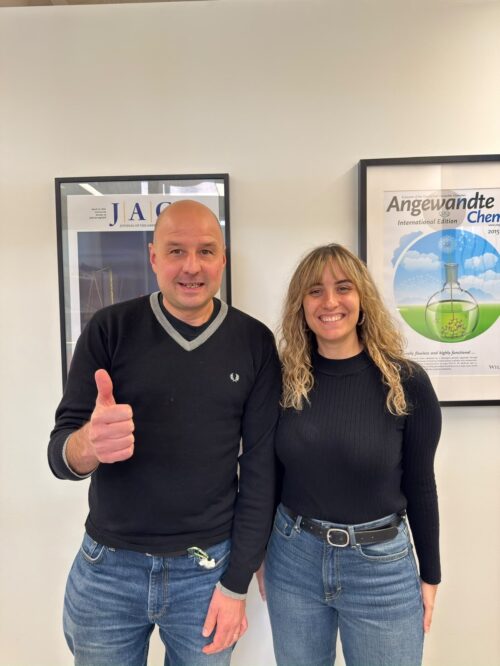
The project also needs to know how the evolved enzymes behave while composite materials degrade. To look into this, ICP-CSIC PhD researcher Julia Murciano is spending two months at KTH Royal Institute of Technology in Stockholm, Sweden, in the group of Prof. Per-Olof Syrén.
ICP-CSIC brings its experience in directed evolution to the stay. KTH, for its part, contributes its knowledge of polymer science and materials characterisation. Working side by side, the two groups want to find out how the engineered enzymes interact with bio-based resins.
How enzymatic recycling of composites fits into BLADE2CIRC
BLADE2CIRC is developing wind turbine blades with a circular, safe and sustainable design. Coordinated by Fundación Aitiip, the project brings together 11 partners from five countries. Its work ranges across bio-based materials, reversible adhesives and self-healing coatings. Alongside these, it explores chemical and enzymatic routes to break down end-of-life parts, and this is where ICP-CSIC’s enzymes come in. If the tests go well, they could help recover materials from these parts instead of sending them to landfill.
Want to keep up with BLADE2CIRC and its partners? Follow the project on LinkedIn for the latest news from the consortium.